#3 OVERTIME Edge | Michael Phelps: The Shark Who Nearly Drowned
Twenty-eight Olympic medals and an impossible void to fill: the fall and resurrection of the greatest Olympian in history.

WARM-UP ⏯️
When you put tremendous effort into something and finally achieve it, satisfaction comes but it's fleeting. We believe our achievements entitle us to eternal happiness, but that’s incredibly naive. That's why I believe happiness must be tied to a purpose rather than just achieving goals 💡
Many elite athletes, especially those who put everything on the line every four years at the Olympics, suffer from what's known as post-Olympics blues. After years of preparation at the limit, with countless personal sacrifices, some touch glory in the best-case scenario. But when they return home, uncomfortable questions arise: What is my life's purpose? Who am I as a person? What do I know how to do beyond swimming? ⚠️
Post-Olympic crises are a devastating reality. Today we're going to talk about Michael Phelps, perhaps the greatest example of how even absolute excellence doesn't make you immune to those internal battles 👇
The Baltimore Shark 🦈
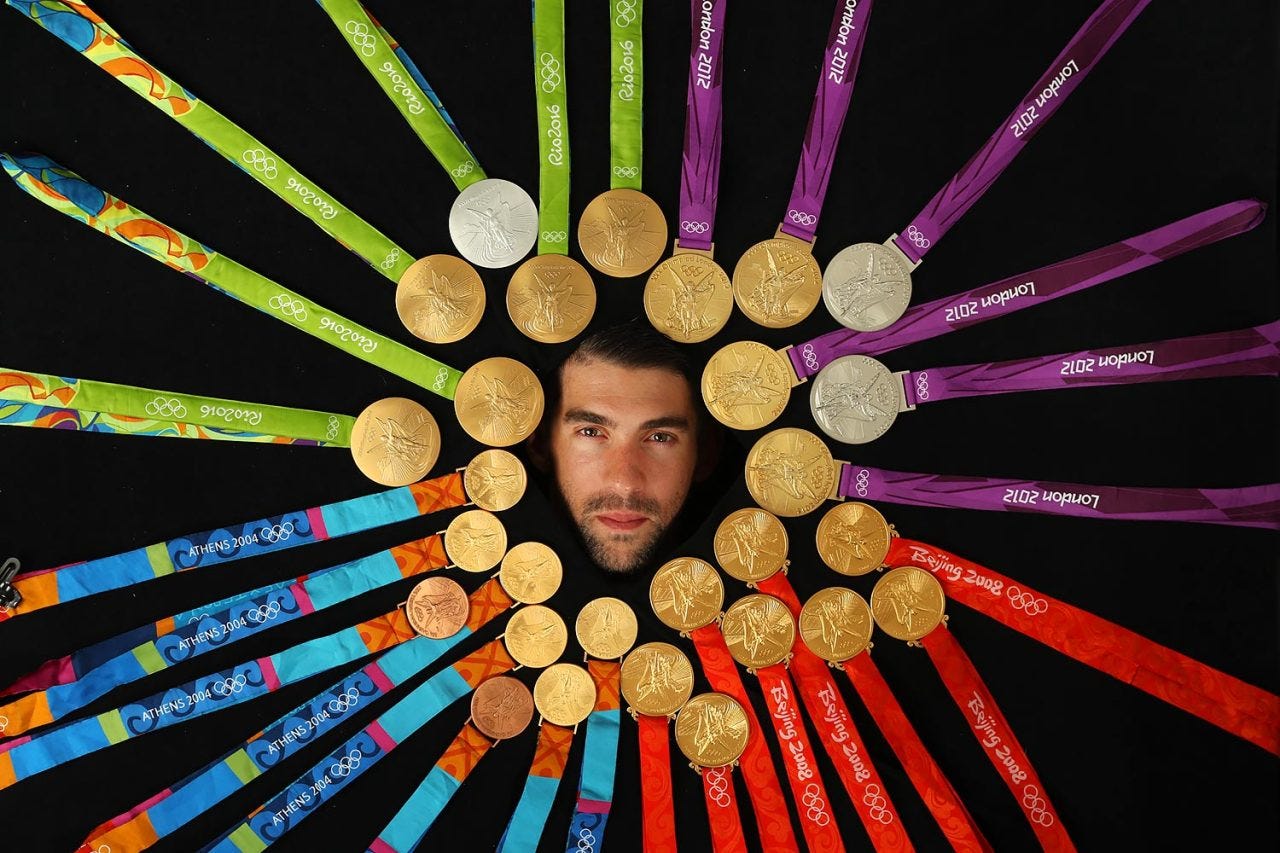
Michael Phelps is the most decorated athlete in Olympic history: 28 medals across five Olympics (Sydney 2000, Athens 2004, Beijing 2008, London 2012, and Rio 2016), 23 of them gold. To put it in perspective: no other athlete has surpassed 10 golds 🏆
Excluding Sydney 2000, where at 15 he achieved a fifth place that announced what was to come, we have an average of 7 medals per Olympics. He alone has won more than entire countries 🤯
Physical Prodigy + Elite Mentality
6’4’’ tall, with an arm span of 6’8’’ and feet that acted like natural fins (size 14 US), Phelps had biomechanical advantages straight out of a Marvel lab. But physique without work is worth nothing.
He started swimming at 7, and by 10 he met Bob Bowman, his lifelong coach, who instilled in him a work ethic based on one mantra: “If you want to be the best, do what others aren’t willing to do.” ⚔️
That meant training 6 hours a day, 6 days a week, 50 miles of swimming per week, plus gym work. A 10,000-calorie diet and obsessive focus on recovery. Even Whoop in its early days tested their bands on him and were amazed by his recovery metrics (here's the interview with Will Ahmed, its founder!)
Post-Olympics Blues: The B-Side of Success 😶🌫️
Physically flawless. Mentally fragile
Phelps admitted that after every Olympic Games, he went through depressions. MP the person and MP the super-athlete had become one and the same in his mind. Makes sense: for years you wake up with one crystal-clear mission. The Olympics arrive, you compete, and if you’re an alien like Phelps, you dominate. But then comes the void: Now what?
The Self-Destructive Pattern 🌋
Athens 2004: At just 19, he tied the record for most medals by an American in a single Olympics. Weeks later? Arrested for DUI. 18 months probation, a fine, and public apologies.
Beijing 2008: At 23, at the peak of his career, he won 8 golds, breaking Mark Spitz’s legendary record, setting 7 world records in the process. In February 2009, a photo of him smoking marijuana at a party is leaked. Three-month suspension for unsportsmanlike conduct.
London 2012: 6 more medals: MP becomes the most decorated Olympian in history. These were supposed to be his last Olympics. Afterward: deep depression, total identity loss outside of sport, even suicidal thoughts. In 2014, arrested again for DUI (this time nearly triple the legal limit). Six-month suspension and a voluntary stint in rehab ⏬
Rewriting the Script ✍️
Phelps consciously faced his problems for the first time. He was drowning, and therapy became his lifeline. He realized life could have meaning beyond medals. He decided to return to competition with a different approach: balance and love for the sport.
Rio 2016: His final Olympics (where he was chosen as the U.S. team flag bearer). Six more medals. For the fourth consecutive edition, Phelps was the athlete with the most medals at the Games, consolidating an unreachable legacy and closing an unmatched athletic career 🎖️
Michael Phelps ™️
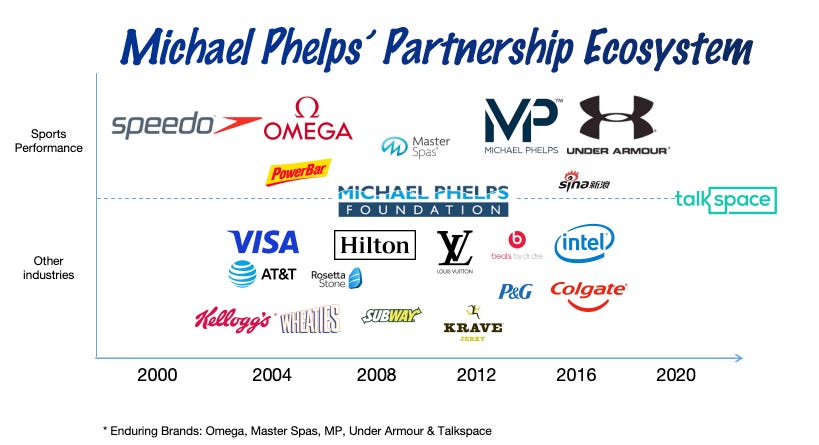
After the success of Athens 2004, Michael Phelps (19) became one of the highest-paid athletes in the world. His agent—Peter Carlisle, also representing Simone Biles—closed deals with Speedo, Visa, Omega, AT&T, PowerBar, Hilton, Rosetta Stone, and other brands, totaling around $5 million annually.
But the golden-boy image cracked with the 2009 and 2014 scandals. Example: Kellogg’s dropped him, claiming his behavior clashed with their “family image.” Still, his legendary status withstood the hits. Many brands valued his honesty in acknowledging mistakes and his willingness to make amends, maintaining long-term relationships.
📦 Business Playbook: Lessons from Phelps for Brands and Athletes
For brands:
Post-crisis authenticity: transparency can weigh more than a spotless record.
Value alignment: the best partnerships are built on shared purpose.
Long-term vision: backing an athlete during their rebuild can pay off more than at their peak.
For athletes:
Transition planning: separate your personal and professional identity before retiring.
Crisis management: admit mistakes quickly and consistently.
Purpose-driven narrative: your story can matter more than your medals if it connects with people.
The Turning Point 🩹
The defining moment came in 2014, in an Arizona rehab clinic. He realized he wanted to leave a legacy beyond sport. He acknowledged his depression, admitted professional help saved his life, and decided to return to prove success can be achieved with balance and purpose.
Along the way, he teamed up with Under Armour, his hometown brand. Their “Rule Yourself” campaign showed Phelps training alone in the dark, underlining the truth: his fiercest competitor was always himself 💥

Phelps and Mental Health 🧠
Phelps has done enormous work dismantling the myth that champions "have it all and are always happy." He's the face of Talkspace for online therapy, was executive producer and narrator of the documentary The Weight of Gold (HBO, 2020), and is a regular speaker at conferences on leadership, wellness, and high performance. His talks revolve around three key lessons: setting clear goals, daily discipline, and asking for help when needed.
The Michael Phelps Foundation 🏊♂️❤️
Founded in 2008 with the $1M bonus Speedo gave him for breaking Spitz’s record, its initial mission was to promote swimming and water safety for kids. Over time, it expanded into mental health and family wellbeing. Phelps says, along with being the best father and husband he can be, this is what makes him proudest 🔝
Economic Impact 📊
By 2016, Phelps had racked up over $94 million in contracts and endorsements, plus about $7 million in bonuses and prize money. Today, in retirement, he still earns $7–9 million annually through deals with Under Armour, Omega, and Talkspace, plus a speaking circuit that pays $100k–150k per appearance.
The difference? He no longer earns by breaking records—he earns by sharing how a champion rebuilds.
Beyond the Records 🎯
Michael Phelps proved you can be the best in the world and still be broken inside, still need help—and that asking for it doesn’t make you weaker, just more human.
His public admission of depression didn’t just change his career—it changed sport forever. Before him, admitting mental health struggles was practically professional suicide. After him, it became a sign of courage (as we saw with Simone Biles in the last post).
The key is finding a purpose that transcends fleeting achievements. That’s not easy: it demands learning more about ourselves, asking uncomfortable questions, and accepting answers we might not like.
I don’t think we’ll ever see another athlete like him. His records will carry his name forever, but what will truly remain is his story and the lives he inspired to keep fighting 🦈
OVERTIME Edge Recs 💎
📚 The book that opened Michael Phelps' eyes in rehab: The Purpose Driven Life by Rick Warren. Once I finish The Almanack of Naval Ravikant, it’s next on my list.
🎙️Becoming Michael Phelps on The Tony Robbins Podcast & #494: Michael Phelps and Grant Hackett on The Tim Ferriss Show. Pure gold. Ever since hearing him speak, my admiration for MP has only grown
🎬 The Weight of Gold (HBO), which captures the pressure, loneliness, and struggles that come when the Olympics end.
🇪🇸 Want more sports business content in Spanish? Check out OVERTIME 👇